How Much Does Ceiling Fan Installation Cost?
Ceiling fan installation typically costs $150 to $300 to swap an existing fan or light on a fan-rated box, and $250 to $450 when the electrical box needs upgrading or the location is new. The fan itself is separate. Almost the entire safety and pricing story comes down to one part most homeowners never see: the electrical box in the ceiling, which must be rated to hold a fan's weight and vibration.
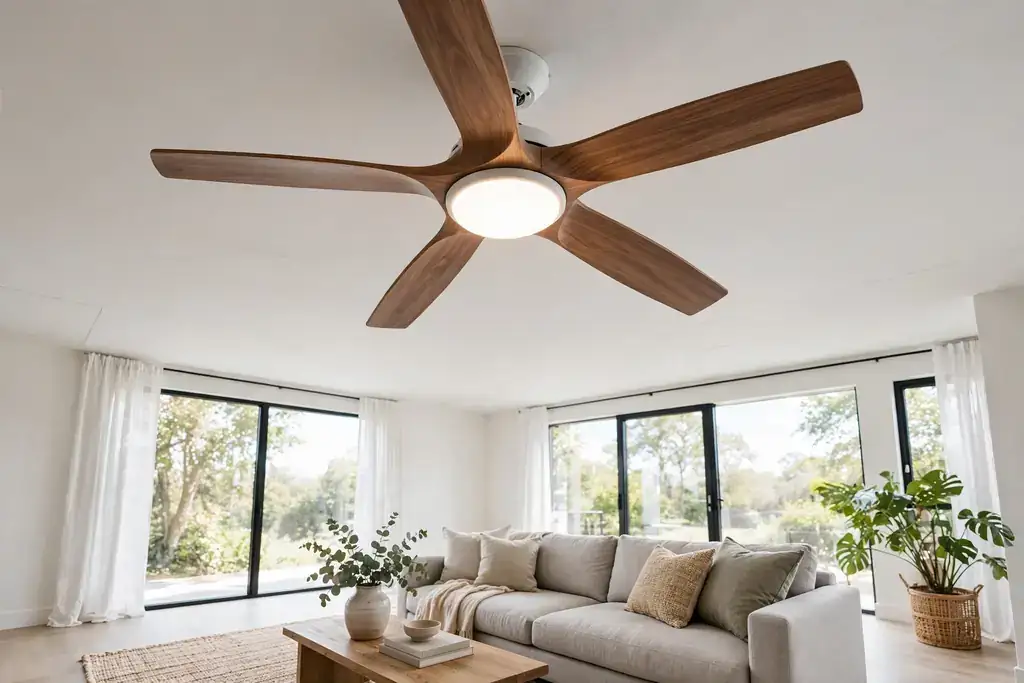
Ceiling fan installation prices by situation
No two ceiling fan quotes are alike because no two ceilings are alike. What the installer finds above the drywall — the box, the wiring, the bracing — sorts every job into one of these rows.
| Situation | Typical range | What the price covers |
|---|---|---|
| Swap an existing fan, box already fan-rated | $150 – $300 | Old fan down, new fan assembled, hung, balanced, and tested |
| Replace a light fixture with a fan | $200 – $400 | Box inspected and usually upgraded to a fan-rated brace box |
| Fan where no fixture exists | $350 – $700 | New box, bracing, and wiring run from a switch or nearby circuit |
| High or vaulted ceiling | Add $75 – $200 | Tall-ladder or scaffold work, downrod sizing and fitting |
| Remote receiver or smart control setup | Add $40 – $100 | Receiver wired in the canopy, remote paired, wall control configured |
The fan-rated box is the whole job
A ceiling fan is not a heavy light fixture. It is a motor that spins for hours at a time, and the vibration works on whatever holds it. A standard fixture box is rated for a static light; a fan-rated box is braced to the joists and rated for the fan's weight in motion. Fans hung from ordinary boxes are the ones that develop a wobble, chew through their mounting screws, and occasionally come down. Any installer quoting a fan swap should be checking the box first — if yours turns out to be a plain fixture box, the upgrade is not an upsell, it is the job.
This is also where handyman scope sits comfortably: swapping a fan on existing wiring and upgrading the box are standard handyman work in most states, while running a brand-new circuit from the panel is electrician territory. The ceiling fan installation service page covers how the network scopes it, and an installer who finds panel-side work will tell you before starting.
Labor, parts, and the fan itself
Quotes come in three pieces. The fan is yours to choose — fans run from under a hundred dollars to several hundred, and the install price does not care much which you picked, except that large and smart-home fans take longer to assemble. Parts are the small stuff with an outsized role: the brace box, a downrod for high ceilings, wire connectors. Labor is the rest, and it is mostly the ceiling: a standard eight-foot ceiling in a bedroom is the cheapest fan you will ever install, while a two-story foyer fan can double the labor line on height alone.
Local conditions move these numbers in predictable ways. High summer demand in hot markets tightens schedules — the notes on ceiling fan installation in Corpus Christi describe Gulf-coast specifics, and ceiling fan installation in Lubbock covers the West Texas version, where fans run most of the year and swaps are a spring ritual.
Before the installer arrives
Decide where the fan goes and what controls it: a pull chain is fine until the ceiling is twelve feet up, at which point a remote or wall control stops being a luxury. Check the box the fan comes in — blades, downrod, and remote receiver all need to be in the house, because an installer standing under your ceiling with a missing part helps nobody. And clear the floor under the fixture; ladder work needs a clean footprint.
Booking this alongside other electrical-adjacent installs is common — the TV mounting cost guide covers the other half of a living-room upgrade, and our guide to handyman hourly rates explains when a fan swap prices better as a task than by the hour.
Sizing the fan to the room — and the ceiling
Two specifications quietly decide whether a new fan actually cools the room or just stirs it. The first is blade span against room size: fans around 42 inches suit small bedrooms and offices up to about 100 square feet; the common 52-inch fan is sized for rooms up to roughly 225 square feet; great rooms and open plans want 60 inches or more, or two fans working the space. An undersized fan on high speed moves less useful air than a correctly sized one loafing on medium, and it does it louder.
The second is mounting height. Fan blades should sit between seven and nine feet from the floor — low enough to move air across the people in the room, high enough for clearance and safety. On a standard eight-foot ceiling that means a flush mount. Every foot of ceiling above nine calls for a downrod that brings the fan back into the working zone, which is why vaulted-ceiling installs carry the surcharge in the table above: the downrod itself is cheap, but fitting it is ladder work at height. Tell dispatch your ceiling height when you book and the installer arrives with the right rod the first time.
Porches, bathrooms, and damp-rated fans
Location changes the fan you may install. Fans carry location ratings: dry-rated for bedrooms and living rooms, damp-rated for covered porches, bathrooms, and laundry rooms where humidity is routine, and wet-rated for positions exposed to direct water. Installing a dry-rated fan over a porch is not a paperwork offense — it is a corrosion schedule, with the motor and finishes degrading in the damp air. The rating is printed on the box and in the listing, and matching it costs little or nothing extra at purchase, while swapping the wrong fan costs a second install. Kitchens deserve a mention of their own: a fan there moves cooking heat, but it also collects grease film, so choose blades you can wipe and expect the balancing to need a check after the first deep clean.
Fans are one line on a longer list for most houses; the nationwide network overview shows every other job the same call can book.
Frequently asked questions
Can I replace a ceiling light with a fan?
Usually yes, and it is one of the most common fan jobs. The catch is the box: the light's box must be replaced with a fan-rated brace box unless it already is one, and the installer will verify what is up there before hanging anything. Wiring for a light — one switch, one hot wire — works fine for a fan with a remote or pull chain.
How long does ceiling fan installation take?
A straight swap on a fan-rated box takes about an hour to ninety minutes, including assembly and balancing. A box upgrade adds roughly half an hour. A brand-new location with wiring to run is a half-day job and may involve an electrician, depending on what the wiring requires.
Why does my quote mention balancing?
A fan that wobbles at speed is either mounted on the wrong box, has uneven blades, or was never balanced. Balancing — checking blade heights and fitting small weights — is part of a complete install, not an add-on. A properly balanced fan on a rated box runs silently for years.
Should the fan spin a certain direction in summer?
Yes: counterclockwise in summer, which pushes air down and creates the breeze that cools skin. Clockwise on low in winter recirculates the warm air pooled at the ceiling. Most fans reverse with a small switch on the motor housing — worth knowing before you assume the fan is underperforming.
Book a fan install before the heat does
One call covers the swap, the box check, and the balancing — matched to a local pro.
Call (877) 705-6325